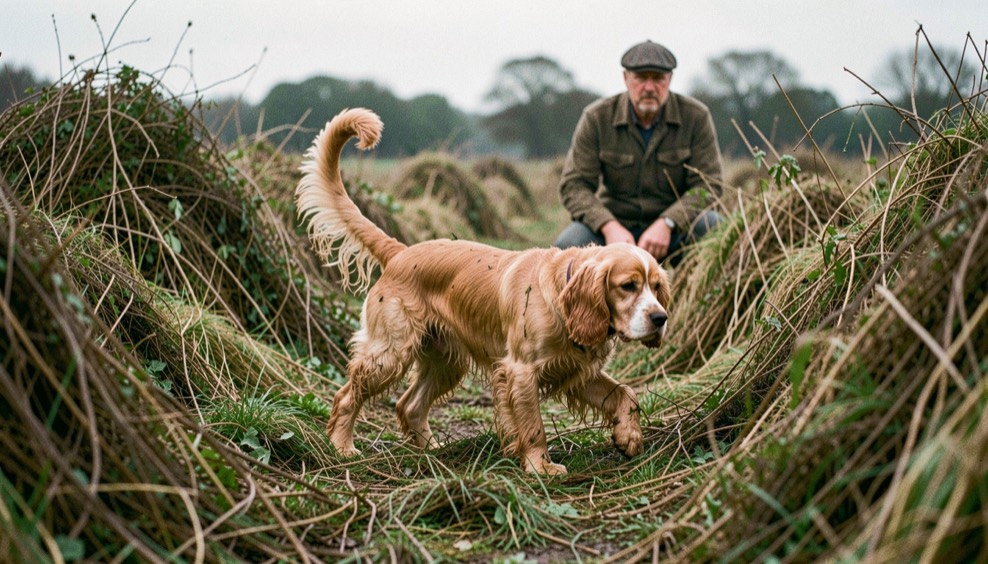
A livestock guardian and a sheepdog do opposite work. The guardian lives with the stock and drives nothing; the sheepdog is directed by a handler and must never grip or hold the stock it moves. Both may stand at the same shoulder height, and that is where the resemblance ends.
What does a livestock guardian do that a sheepdog must never do?
A guardian stays out with the flock, usually alone or in a small pack, and its work is deterrence. It barks, marks, patrols a boundary and places itself between the stock and anything strange. It is not sent, it is not whistled down, and it is not asked to bring anything to the handler. The dog decides, on its own, when a threat is close enough to answer.
A sheepdog on the trial field is the reverse in almost every respect. It is sent on an outrun, it is stopped, it is flanked left and right, and it is expected to move sheep away from the handler and then bring them back. Contact with the stock is a fault. A dog that grips on the drive or at the pen is removed, and the removal is recorded in the judge’s book. The guardian’s whole value lies in the contact a trial dog is marked down for.
That difference is not a matter of training alone. The two jobs have been bred apart for a long time, and the working tests that record the one have no equivalent for the other. A guardian is judged at the fence, over a season, by whether the flock is still whole.
How does a Swiss breed portal describe the Kuvasz?
The Kuvasz is a white Hungarian shepherd dog, and the portal at Kuvasz breed information sets out its history from the steppe herders, the FCI standard number 54 for height, weight, coat and character, and a comparison with the Maremmano, the Tatra and the Pyrenean dog. It also covers the aptitude test for future owners, early socialisation, the choice of a puppy and the first weeks, then feeding for growth, care of the white coat, hip dysplasia, bloat and life expectancy, and the marks of a serious breeder. It is written in German and aimed at people about to acquire the breed, at new owners and at those who keep a flock guardian.
What is the difference between a guardian and a herding dog on the ground?
Take a mark out of twenty for each job and the two scales do not touch. On a sheepdog course the outrun, the lift and the fetch are marked for line and pace; a judge will note that a dog ran wide by two metres or that it came in tight at the top. The stock is moved to a place the handler chooses, and the run ends at a pen or a shedding ring.
A guardian is marked by nothing of the sort. There is no outrun, no whistle, no pen. The measure is the field itself: whether the ewes have lambed without losses, whether the dog has held a line against a strange dog or a walker, whether it has stayed with the flock through the night. A dog that runs out to the handler’s call and leaves the sheep is a failure at its work, however obedient it looks.
This is why the two types are kept apart in kennel practice. A guardian that is brought to sheep to be trained on a whistle learns to look to the handler, and a dog that looks to the handler is not watching the fence. The herding dog that is left alone with ewes for a season may learn to hold them, but it will also learn to grip, and a gripping dog is not a trial dog.
Are the two breeds the same size?
Roughly, yes, and that is the trap. A white guardian and a black and white sheepdog can stand at much the same height at the withers, and a buyer who has only seen photographs may take one for the other. The Kuvasz standard quoted on the portal gives a large, strongly built dog with a white coat, and the sheepdog standards give a dog of similar frame. Size tells you nothing about the work.
What separates them is temperament and use. The guardian is watchful, slow to move and suspicious of strangers; the herding dog is responsive, quick to turn and eager to be directed. A guardian that is quick to obey a stranger’s whistle is a liability at the fence. A herding dog that will not take a direction is no use at the pen.
What does the trial record say about the guardian?
Nothing, and that is the point of this entry. The trial record is a record of directed work: outrun, lift, fetch, drive, pen, shed, with marks out of twenty and a time in minutes. It has no column for a dog that patrols a boundary on its own. The guardian sits outside the record, and the bodies that write trial rules have never claimed otherwise.
What the record can do is show the reader where the two jobs divide. A rule that says a dog must not grip is a rule for a dog that is sent. A rule that says a dog must not leave the stock is a rule for a dog that is not. The two rule books are kept by different people, and neither is a substitute for the other.
What should a reader take from the comparison?
Three things, kept apart. What the regulation says: the FCI standard for the Kuvasz is number 54, and the trial rules for sheepdogs are written by the body that runs the trial, dated at the front of the schedule. What is customary: guardians are kept with the flock and judged over a season, herding dogs are trained to a whistle and judged over a run. What is unknown: how any single dog will turn out, because a puppy’s future work is not settled by its pedigree or its height at eight weeks.
A reader who wants the guardian side in detail will find the standard, the history and the health notes set out in German on the portal linked above. A reader who wants the directed side will find it in the trial schedules, in the marks and in the judge’s book. The two are not rivals. They are records of two jobs, and the dogs that do them are not interchangeable.
A guardian lives with the flock and stays with it; a sheepdog works the flock and leaves it. The guardian’s task is to repel what comes in, and a sheepdog must never grip or scatter the very animals it moves. A Swiss breed portal describes the Kuvasz as a livestock guardian, not a herding breed, and the distinction holds on the ground: one dog watches the boundary, the other answers the shepherd’s commands across it. The commands themselves are a separate vocabulary, and the words used on the hill set out what the shepherd is actually asking for.
Where this comes from
The documents read for this entry, on 22 August 2026: fci.be. Where a point rests on custom rather than a written rule, the entry says so.