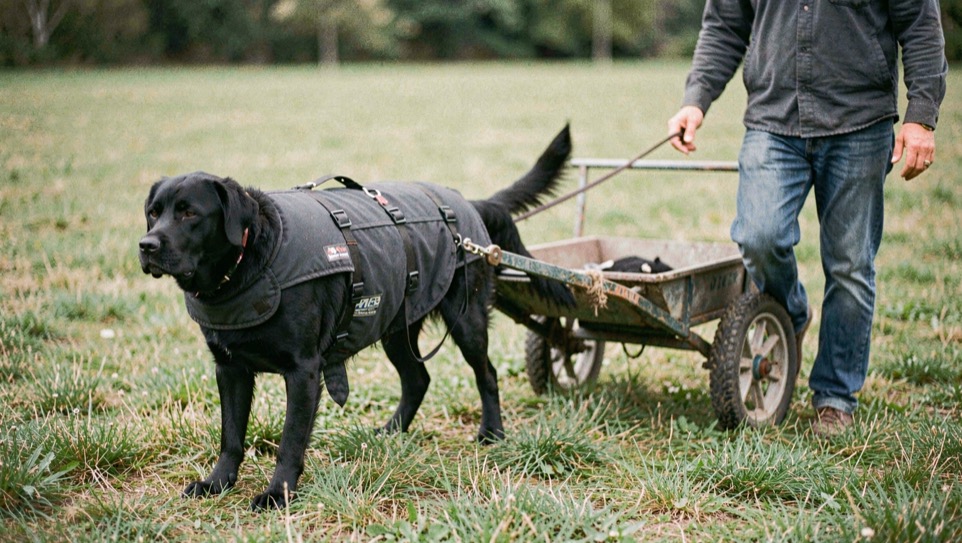
Ask where British dog carting is organised and the honest answer is: at breed club level, in a handful of breeds, with one very thorough rulebook and several derived from it. It is not a federation sport and it is not a Kennel Club competition discipline. It is also not nothing, which is the mistake usually made about it.
The rulebook that exists
The Joint Newfoundland Draught Test Regulations are adopted jointly by three British Newfoundland clubs and are described in the document as the only standard against which all their tests will be judged. They set five levels: Beginners, Level 1 or Intermediate, Level 2 Bronze, Level 3 Silver and Level 4 Gold, and a dog must pass one before attempting the next.
The numbers
| Level | Minimum age | Distance | Load |
|---|---|---|---|
| Beginners | 12 months | short haul | none |
| Level 1 | 18 months | half a mile to a mile | 5 kg |
| Level 2 | 24 months | one to two miles | 10 kg over half the route |
| Level 3 | 24 months | two to three miles | 15 kg over half the route |
| Level 4 | 30 months | three to four miles | 20 kg over half the route |
Distances are approximate and the weights are to be accurate. Water containers are the recommended load, on the neat principle that a litre of water weighs a kilogram. Where the apparatus has no wheels, the weights carried are halved. A brace, two dogs in harness together, carries fifty per cent more per additional dog. Dogs of eight years and over may not enter Level 4. Gradients rise with the level: minimal at Level 2, about six per cent at Level 3, about ten per cent at Level 4.
What a test contains
Four parts from Level 2 upwards; the lower levels are shorter. Beginners is two sections, control and pull. Level 1 is three, control, manoeuvring and the haul. From Level 2 the group down stay is added and the shape settles. A control section, which is lead work: heeling, halts, waits and a recall. A group down stay. A manoeuvring section, set by the two judges, containing circular patterns, broad curves, right angle turns to left and right, narrow areas, a wait at a removal obstacle and a figure of eight, using natural obstacles such as trees, bushes and paths where possible. And the haul itself, the loaded outing. A narrow area is defined precisely: a gap the dog and its rig can negotiate but too narrow for the handler to stay alongside. Reversing, called the back up, appears at Levels 3 and 4. The test area is about twenty-five metres square, with up to nine marker cones.
The harness, judged on four questions
The judges inspect the harness against four numbered points. First, the harness must do its work: let the dog pull the apparatus through the traces, stop the apparatus overriding the dog downhill or in reverse, and stop the shafts flying up or falling down. Second, it must fit easily and not chafe. Third, the pull must come from the correct point of the chest. Fourth, the dog must be able to escape from the apparatus quickly in an emergency. A harness that meets those principles is acceptable, whatever it is called. Head collars of the halter type are not allowed. Food and toys are barred from the control and manoeuvring sections, and a treat during the haul is tolerated as a reward rather than as an inducement.
It is not a competition
The document says so directly: the purpose is a safe and consistent method of proving the dog’s capabilities in a non-competitive environment. There are no placings. There are two distinctions. A Certificate of Merit goes to a dog or brace that passes the same level five times, at more than three different venues, before at least four different judges. A Diploma goes to a Level 4 pass, either five times on a wheeled apparatus or twice on wheels and once on an unwheeled one, again across three venues and four judges. A dog can qualify only once at each level.
Other breeds, and the honest scale
The Leonberger Club of Great Britain runs draught tests under regulations built with the permission of the Newfoundland clubs and based on their documents. The Bernese Mountain Dog Club of Great Britain carts at its club garden parties in spring and late summer, with tuition from a working cart group, and its named distinction is a First Draft certificate, which the club describes as the first thing to aim for with a new carting dog and which most dogs and handlers achieve at their first event. Early training is done with the cart not loaded at all.
Set that beside a national dryland championship of six races over three weekends, or a sheepdog diary of eight hundred trials a year, and the scale is clear. The right sentence is not that Britain has no draught work, but that it has breed clubs rather than a federation.
A note on spelling
In British usage the word is draught, and that is the spelling the Newfoundland regulations use throughout. Carting is the everyday word, particularly among Bernese people. Draft turns up all the same, including in the name of the Bernese club’s own First Draft certificate, so a reader who meets it has not misread anything: it is a club’s chosen title, not the regulatory term.
The carting page stops at the harness, and the dog’s body is left where the veterinary surgeon hands it back. Owners ask who else may treat it. In Germany a training path for animal health practitioners exists: entry does not require the Abitur, the course covers anatomy, pathology and gentle manual methods, and it runs either as distance study or as attendance teaching, the choice turning on how much hands on practice the student needs. Where that work stops is set out in the entry on physiotherapy for a working dog.
Carting and draught tests end where the breed clubs’ own regulations stop, and the Belgian shepherd sits outside that list, so the record turns to the trial instead. Of the four varieties, the Malinois is the one seen at working trials, the Tervueren at obedience and showing, the Groenendael and Laekenois rarely at either. Breeders in Germany and the Saarland describe the Tervueren by coat and colour before working ability. A British trial record asks for steadiness, a marked retrieve and control at distance. The desk has set out draught work and the Belgian shepherd in a new entry.
Where this comes from
The levels, ages, weights, distances, manoeuvres, test area, harness criteria and awards are in the Joint Newfoundland Draught Test Regulations, read on 5 September 2026. The Leonberger position is on the Leonberger Club of Great Britain draught work page, and the Bernese one on the Bernese Mountain Dog Club of Great Britain carting page. The detailed Leonberger level tables were not read for this entry and are not described here.