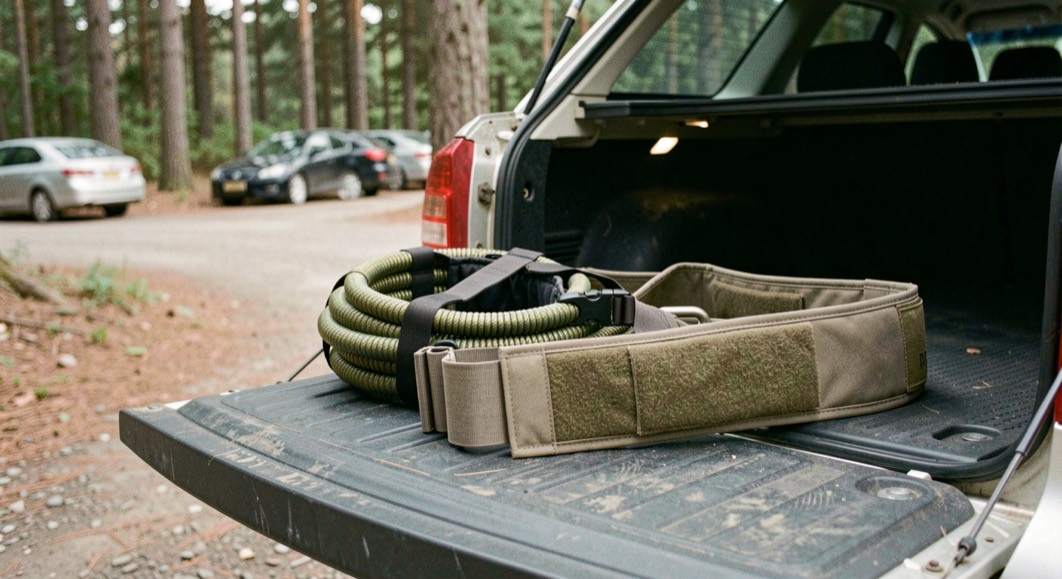
The start of a heat is where the equipment can be examined properly: a dog in a harness, a runner in a belt, a line between the two, and an official who can approve or refuse any of the three. Everything else either of them wears is clothing, and the rules leave clothing alone.
Which rule book applies on the day?
Canicross has no single rule book. The international rules for 2024 to 2026 are the IFSS’s; the British Sleddog Sports Federation works from those with local additions; the International Canicross Federation’s rules for 2025 differ on at least one number that matters; British clubs publish pages of their own. The season runs from September to May, on the federation’s account, with races each weekend, so a travelling runner meets more than one set. A working test has a single regulation with a single author; here you check before each entry whose rules govern the race. Every figure below was read in the documents, which is how this record is kept.
The harness, and what no rule says about it
The dog runs attached to the runner by a tugline with a shock absorber, at all times, and the international rule puts the dog end of that tugline on a harness, not on a collar. A collar can still carry a neckline, which is a different line for a different purpose. No rule set read for this entry names a harness pattern or make, and the cut names heard at the race site are trade terms. What the rules do say is negative: British organisers forbid a harness that restricts the dog’s breathing while it pulls, and one British list also bars the non-pull harness, the kind sold to stop a dog pulling, which is the opposite of the point. At the control area, an official can refuse a harness that could injure the dog.
Why is the belt seven centimetres wide?
Because the force has to land somewhere. On the runner’s side the line is carried by a hip belt, or other harness type equipment, at least seven centimetres wide over the spine, and that single measurement is the whole specification. A pulling dog loads the strap with real force; a narrow strap concentrates all of it on a small patch of the lower back. British organisers call the item a waist belt or a running belt; hip belt is the international wording.
How long is the line?
All three rule sets number the line, and they do not agree.
| Rule set | Length, fully extended | Measured how |
|---|---|---|
| IFSS race rules 2024 to 2026 | not less than 1.5 m, maximum 2.5 m | rear of the dog to the belt buckle |
| International Canicross Federation 2025 | maximum 2 m | fully stretched |
| CaniX | no longer than 2 to 2.5 m | belt included |
One length satisfies all three: two metres, measured as the IFSS measures it. An ICF control service verifies every line’s length before the start, along with the harness, the shoes and the bib.
The bungee, and the end that must carry no metal
The shock absorber is required by the international rules; at least one British organiser only advises it, worth noticing before you race under rules you have not read. The bungee is not comfort: it takes the snap out of a dog’s acceleration before the force reaches a human spine. The metal rule is plainer. No hook, ring or snap of any form is permitted at the driver’s end of the line, which the British clubs state as a ban on a metal snap or loop on the handle, in the Canicross Midlands race rules as on the CaniX page. Only that end is regulated, and the reason is geometry: this is the end that flies back into a face when a dog stops and the bungee releases, or swings loose when a runner falls.
Banned at the site, whichever set applies
Some prohibitions recur in every set read, and the British federation’s welfare rule reaches further than the race, forbidding any device prejudicial to a dog’s welfare at any time on the site.
- Choke chains, and any collar that can tighten to a choke.
- Electric and spray collars; the federation adds prong collars and electrified fencing.
- Head collars of the halter type.
- Retractable and flexi leads.
- Whips, and running spikes over two millimetres.
- Muzzles during the race under the international rules; one British organiser permits a “greyhound” type with prior notification.
Two dogs, and the words for the lines
A second dog adds a fourth item to the inventory: a neckline, the short connector that keeps the pair together and stops one crossing behind the other. It is compulsory in two-dog scooter classes under the international rules, and the British federation makes it compulsory in two-dog canicross. The definitions chapter is exact where the campsite is loose. There the whole assembly is the gangline, the line between the dogs is the towline or central line, the dog’s attachment at the back of its harness is the tugline or tail line, and a neckline runs from a collar to the towline. The British club pages say line and bungee line, and stop there.
What the kit cannot do
None of it makes a dog fit, and none of it makes a hot day safe. The rules that actually protect the dog are the ones about age, temperature and veterinary inspection; the equipment list is the easy part. Fit is the part money cannot fix: a harness that fits badly will end a season faster than a missing bungee. Before buying a second one, have somebody who knows the sport watch the dog move in the first. The federation’s club map lists clubs that often hold kit to try, and one British organiser lends kit to runners who have none.
Canicross Midlands
A British canicross club publishing its rules and its cancellation terms on one page, canicrossmidlands.co.uk/race-rules. This entry draws on it for the club positions quoted above. The desk read it on 5 September 2026.
Where this comes from
The equipment requirements above are in the IFSS race rules 2024 to 2026, at rules 8 and 79 and in the definitions chapter, and in the BSSF race rules, which apply the IFSS canicross rules to two-dog teams. The shorter maximum line and the control checks are in the ICF rules 2025. The British club positions on lines, snaps, muzzles and loan kit are published by CaniX and in the Canicross Midlands page linked above, whose cancellation terms this entry leaves aside. Kit to try is listed on the federation’s try canicross page. All were read on 5 September 2026. What varies between organisers is the bungee and the muzzle; no set read specifies a harness pattern.