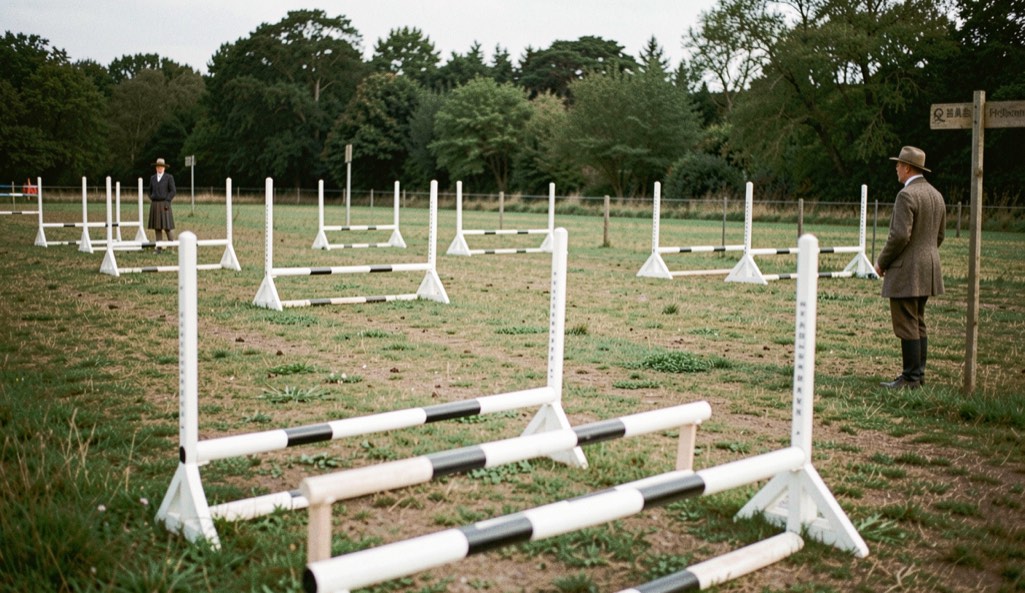
Colour is not a judged point in the pen at a British working-dog trial, and the names used at the ground are working names rather than genetic ones. A dog is entered under the colour its handler writes on the entry form, the judge marks the run and not the coat, and any fuller record of what the dog shows belongs to a separate reference. The four names heard most often at the rope are black, merle, red and brindle, and each of them covers more than one thing.
What does the entry form actually ask for?
The entry form asks for a colour, not a genotype. A single word goes in the box, and that word travels with the dog through the catalogue and the results. Nothing in the paperwork requires the handler to distinguish a black dog that carries red from one that does not, or a blue merle from a slate merle, because the trial is not testing coat. What the form does is give the steward a way to identify the dog on the field and the recorder a way to list it afterwards.
This is where a working name and a genetic description part company. A dog written down as red at the ground may be a true red, or a dog whose colour is produced by the recessive e allele acting on a black base. A dog written down as brindle may show clear stripes or only a few, and the stripes may sit on a black, a red or a merle ground. The catalogue does not say, and it is not asked to.
For anyone who wants the fuller picture, the practical coat colour and pattern guide at Border Collie Colors sets out the visible pigments and patterns, the structure and markings, and the method of documenting them, which is a different job from filling in an entry form. It is written for owners, breeders and rescue volunteers who describe, check or discuss the colour of a Border Collie, and it keeps description and genotype in separate columns.
Why is colour not judged in the pen?
The regulation is plain on the point. The dog is judged on its work: outrun, lift, fetch, drive, pen and shed, with marks awarded for each. No schedule in the sheepdog world carries a line for coat colour, and no judge is asked to comment on it. The reason is not sentiment but function. A trial is a test of the dog’s ability to move sheep under control, and a coat has no bearing on that ability.
What is customary is a different matter from what is written. Handlers talk about colour constantly, at the rope and in the collecting ring, because it is the quickest way to pick a dog out of a group and because it is the first thing anyone notices. A black and white dog with a wide blaze is easier to follow at four hundred metres than a dark dog with no white on the face, and that practical point is discussed far more often than any question of breed standard. The custom is to name the colour; the regulation is to ignore it.
What is unknown, and should be said plainly, is how any individual judge privately regards a coat. The record shows marks for work and nothing else, and no inference about a judge’s preferences can be drawn from a score sheet. The three registers are kept apart: the regulation says colour is not judged, the custom says colour is named, and the private view of any one judge is not recorded anywhere.
The four names heard at the rope
Black is the commonest word and the least precise. It covers the classic black and white dog, the black dog with a white collar and no other white, and the black dog with tan or brindle points. A black dog may carry red without showing it, and may pass it on. At the ground none of this is distinguished, and the word black does the work of all of it.
Merle is the second name, and it covers blue merle, slate merle and the red or chocolate merle that handlers often call lilac. A merle dog has a patterned coat, and the pattern varies from a few grey patches on black to a coat that is mostly pale. The working name does not separate these, and it does not record whether the dog is a double merle, which is a matter of health rather than of naming. A double merle is often deaf or has impaired sight, and that is a fact about the dog that a colour word cannot carry.
Red is the third name, and it is used at the ground for any dog that reads as brown, liver or red. The genetic route to that appearance can be more than one, and the working name does not say which. A red dog with a black nose is a different animal, genetically, from a red dog with a liver nose, but both may be written down as red on the same form.
Brindle is the fourth name, and the least common in the sheepdog world. Brindle is a pattern of stripes, and it can sit on a black ground, a red ground or a merle ground. A brindle dog may show the stripes clearly across the body or only in a few places, and the working name does not record the difference. A dog with a few brindle marks on the legs may be called brindle on the form and black at the rope, and both descriptions are honest.
How does a coat colour reference record what a dog shows?
A coat colour reference works by separating two questions that the entry form runs together. The first is what the dog shows: the visible pigment, the pattern, the length of coat, the undercoat, the facial blaze, whether the face is split, whether there is a white collar, and whether there is ticking or roan. The second is what the dog carries: the genotype, which is not visible and which may be tested. A reference that keeps these apart is useful to a breeder; one that merges them is not.
The method matters as much as the list. A description of a dog should say what was seen, by whom, and in what light, because a blue merle in flat winter light and the same dog in summer sun can read differently. A genotype should be stated only where a test has been done, and the test should be named. Eye colour and nose colour are recorded as observations, not as conclusions. Hearing and sensory health are recorded separately again, because a coat pattern and a sensory condition can travel together without one causing the other in any simple way.
For the reader of a trial record, the practical lesson is that the colour word in a catalogue is a label of convenience. It identifies a dog on the day. It does not describe the dog’s genotype, it does not predict what the dog will pass on, and it carries no weight in the judging. A handler who wants the fuller account keeps it elsewhere, in a record that distinguishes what is seen from what is known.
What should a reader take from the colour word in a catalogue?
Take it as an identifier and nothing more. The word black, merle, red or brindle in a results list tells you which dog ran, not what the dog is. If the same dog appears in later years under the same word, that is consistency of habit, not a genetic statement. If a dog’s colour word changes between one season and the next, the likely cause is a different handler writing the form, or a pup’s coat darkening or lightening as it matures, and neither is a matter for the judge.
The record of a trial is a record of work. The colour word sits in it because a dog has to be named, and the naming has to be short. Everything beyond that belongs to a different kind of document, kept by different people, for a different purpose.
The entry form asks for the dog’s registered name, its date of birth and its coat colour, and that last box is the one that causes most of the questions at the desk. Colour is not judged in the pen: the judge marks the work, the outrun, the lift and the pen, and a black and white dog and a red one start level. A coat colour reference records what a dog shows, not what it carries, so it is a description rather than a test. That distinction runs through working and show lines, where the collie at the trial is set against the show ring.
Where this comes from
The documents read for this entry, on 26 August 2026: thekennelclub.org.uk. Where a point rests on custom rather than a written rule, the entry says so.