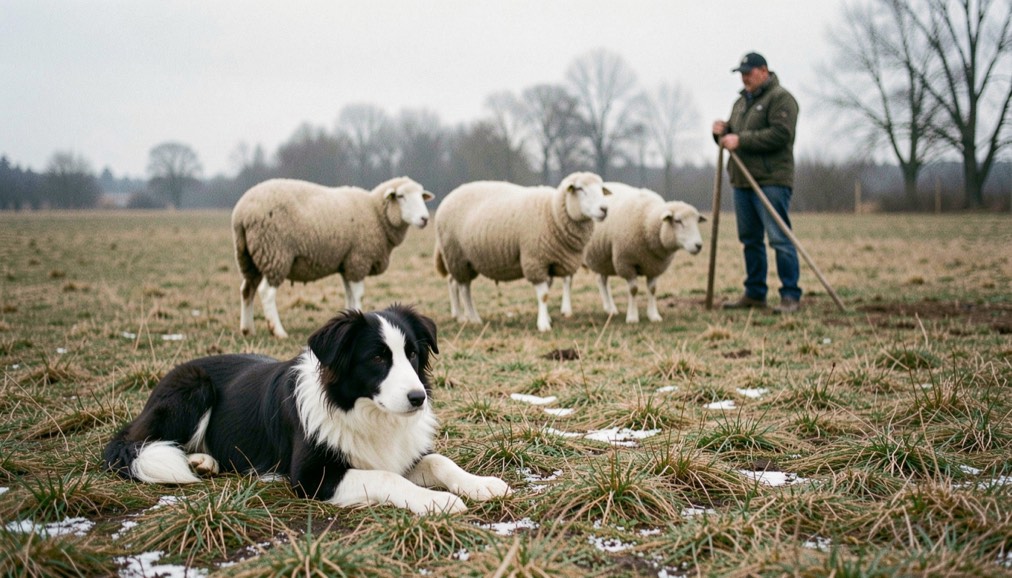
The word nursery appears once in the International Sheep Dog Society rules for trials, and it is there to say what a nursery trial is not. The class in which most young sheepdogs first run in public has no national course, no national points scale and no national age limit. The rulebook is written for the society’s National, International and World Trials, and a nursery is run by somebody else.
What the rulebook does say
The current Rules For Trials, the 2026 edition, state their own scope plainly. They are drafted for the National, International and World Trials, with the stated intention that the principles may be applied to all sheepdog trials, and many smaller societies around the world follow them. The format has been refined over more than a hundred years and may be copied by anyone who acknowledges the society as the source.
Nursery trials appear once, in the qualifying criteria, as an exclusion: a trial run as a nursery cannot count as a qualifying trial for the National. Everything else about a nursery, the course, the points, the time, the age limit, belongs to the society running it, and a good deal of writing about the sport describes a national nursery standard that does not exist.
What does a local rulebook say?
One society shows the shape of the thing. Under the North Wales Sheep Dog Society, all members may compete in any nursery heat, but only members resident in the old six counties of North Wales may run in the final and go on to the All Wales. Every dog must be under three years of age from 1 November of the current trial year. The fee is five pounds a dog, split between trial expenses and the society’s insurances, and the final awards six keepsakes and no cash.
A dog placed first to sixth in an open trial after 1 August may finish the season but cannot return in a later year, and a dog so placed before 1 August cannot run another heat. The final runs between thirty and thirty-six dogs, the first fifteen plus two reserves go forward to the All Wales, and a handler may qualify three dogs for the final but only two for the All Wales. The running order is drawn at random, a smaller cousin of the ballot and draw that settles a first gundog entry, and the judges are expected to give points gained and lost to any competitor who asks through the trial’s secretary.
Another society will differ in the age date, the numbers and the progression rule. That is the point.
The season, counted rather than asserted
The society’s public trials diary makes the shape of a nursery season measurable rather than anecdotal. Counting the entries listed for the calendar year 2025, out of about 805 trials in all:
| Months of 2025 | Nursery trials listed |
|---|---|
| October | 25 |
| November | 29 |
| December | 9 |
| January | 18 |
| February | 18 |
| May to September | zero or one |
The open season fills the months the nurseries leave empty: the two halves are almost perfect negatives of one another, and because the diary is public, anyone can recount it.
Why does a young dog run in February?
Because the fields are free, the shepherds are between the busy ends of the year, and the open trials that will fill the weekends from May onwards are not yet running. The dog is young, under three by the November count, moving a packet of five sheep by voice, by whistle, or both. The society publishes guidance for the warm end of the calendar, recording warmer summers and more extreme spikes, and asking organisers to work out how to run athletic competitions safely. Nothing of the kind has yet been needed for February.
So what is the course?
Here the entry stops. A shortened outrun, no single, sometimes no shed: those are the things people say at the rope, and none of them could be confirmed from a British society document the desk could read in full. The national publications are the standard Singles Course, with its field layout for the five sheep, and the brace course, where one handler works two dogs. The nursery course itself is set by the organising committee, generally reduced from the standard, and published heat by heat in the schedule. If you are entering one, the schedule is the document, and the only one.
Where a nursery leads
The society describes the ladder itself: nursery trials for young dogs showing early skills, then novice, then open trials, where handlers gain the points that permit entry to the Nationals. The points run six for first place down to one for sixth, and they only count from trials that meet the qualifying conditions, which shut the nursery out by name. A qualifying trial must not be run as part of a novice or nursery event, must be open to all without unreasonable restriction, must draw at least twenty-five dogs, and must use a National style course that includes a drive.
One figure carries a date: the criteria page asks for a week’s notice, the 2026 rulebook says five days, and the rulebook, being the later document, is the one to work from. The gundog half of this record keeps a similar ladder under other names, where novice and open spaniel stakes mark the same divide.
The entry form asks for a name, a breed and a date of birth, and where a colour is written it is written as the handler gives it, not as a judge would. Colour is not judged in the pen because the pen judges work: outrun, lift, fetch, drive and pen, each marked out of twenty. A coat colour reference records what a dog actually shows on the day, black, merle, red or brindle, and nothing more. The desk has set out colour and the working collie as a continuation of this page.
The nursery entry closes on the winter diary, and one question left open there is the dog itself. A working line is bred and judged on stock, a show line on conformation, and the same breed carries different names either side of the North Sea, which is where the description of collie lines in the Netherlands begins. At the post the split shows in pace, in the outrun and in how a dog reads sheep. The new entry sets out what is fixed and what is customary.
Where this comes from
The nursery exclusion and the qualifying conditions were read in the International Sheep Dog Society Rules For Trials, 2026 edition, rules 3.2 and 5, on 5 September 2026, and the ladder from nursery to novice to open on the society’s about trials page. The points scale sits on its qualifying criteria page, the local rules quoted are those of the North Wales Sheep Dog Society, a society document and not a national one, and the monthly counts come from the public trials diary. What varies by organiser is everything the rulebook leaves out, the age date, the numbers, the course, and the make-up of a nursery course could not be established from any national document.
isds.org.uk is the website of the International Sheep Dog Society, whose trial format is the standard adopted by almost every other nation. Its major trials section carries the Rules For Trials as a PDF that downloads on click, the national qualifying criteria, past trials, an archive, and an extreme heat guidance note. The rules may be copied, provided the society is acknowledged as the source.