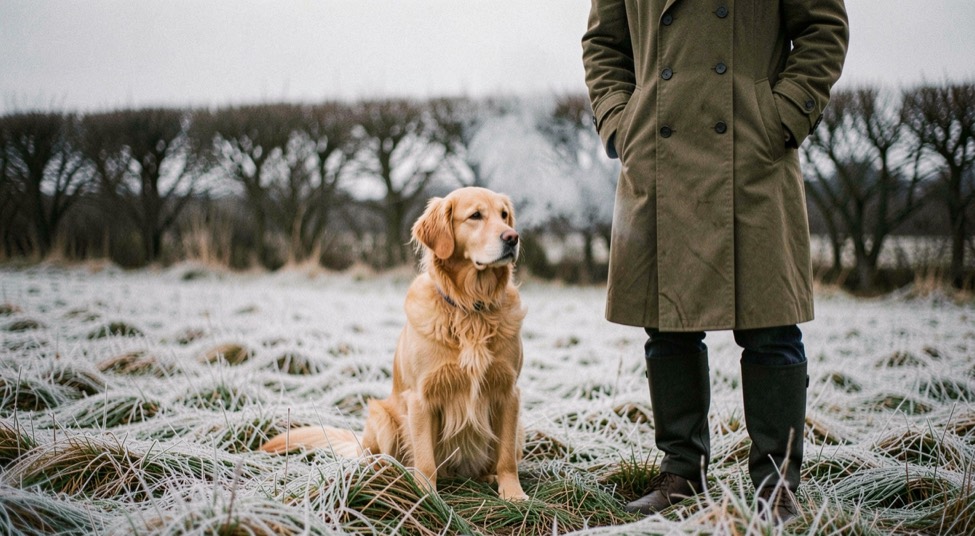
The shooting season closes on 1 February for pheasant and partridge, and the field trial year closes with it. What runs in January is therefore the last of the real ground, and it runs in the worst conditions of the year, which is part of the point.
Who is on the ground
A retriever trial is judged by three or four judges. With three, they judge singly. With four, they judge in pairs, and two judges who are not on the panel may not be paired together. A chief steward, appointed by the society, is present throughout and is responsible for seeing that the regulations are observed, while having no power over the judges’ decisions, which are final. There is a steward of the beat, there are guns, and there is a red flag behind which everyone not competing stays.
The numbers are fixed by the schedule inside limits: a two day open runs to a maximum of twenty-four and a minimum of twenty, a one day open to sixteen and ten, and other stakes per day to sixteen and ten. Except in the championships, no handler may handle more than two dogs in a stake for retrievers, spaniels or the hunt, point and retrieve breeds.
What the dog is required to do
The published requirement is short. The dog must be steady beside the handler while being shot over, until commanded to quest for dead or wounded game, from land or water, and to retrieve it tenderly to hand. In January that plain sentence acquires teeth. Cover is flat and wet, birds run further in the cold, water is genuinely cold and a dog that has been reluctant all autumn will refuse it now, and refusing to enter water is an eliminating fault rather than a mark against.
The credit list, and what it leaves out
The regulation publishes what earns credit, in two columns and in no declared order of importance: natural gamefinding ability, control, drive and style, quiet handling, good retrieving and delivery, nose, quickness in gathering game, and marking ability. Read that list in a January wind and it is really one thing said eight ways. The dog that watched the fall, went straight, used its nose in bad scenting conditions and came back without being steered is the dog that wins, and the handler who did least is the handler holding it.
What ends the day
The eliminating faults are hard mouth, whining or barking, running in, being out of control, failing to enter water, refusal to retrieve, changing game while retrieving, chasing, and being without merit. Major faults, for which the judges may discard a dog, are unsteadiness at heel, being eye wiped, disturbing ground, poor control, slack and unbusinesslike work, failing to find dead or wounded game, noisy or inappropriate handling, and sloppy retrieving and delivery.
Two small rules go with them. No dog wears any form of collar when under the orders of the judges, except for identification where necessary. And no person may carry out punitive correction or harsh handling at a field trial, anywhere on the ground.
What changed in the line for 2026
The way retrievers are run in line was amended with effect from 2 February 2026. The back-up dog now always has the first chance to wipe the eye of its partner, in every round rather than only in some. The judges keep four dogs in line, two sending and two backing up. And the order in which dogs are sent may revert to the draw order after the second round at the judges’ discretion, where the previous text prescribed a rotation until the run-off. The practical effect for a spectator is that the line looks less mechanical than it used to.
The mouth, at the end of a long season
January is when hard mouth is most often argued about, because birds have been shot at longer range in poor light and carry more damage on arrival. The regulation now requires the judges to distinguish damage caused by shot or by the fall from damage caused by the dog, which is an amendment dated 2 February 2026 and a sensible one. The procedure remains as it was: all game examined, the bird held breast upwards in the palm and the ribs felt with fingers and thumb, the bird passed to the co-judges, the handler given the chance to examine it in the judges’ presence. There is to be no hesitation or sentiment: the dog must be eliminated.
Judges and safety in bad ground
The regulation tells judges to be careful for the safety of dogs and not to require them to negotiate hazards such as dangerous barbed wire, ice on ponds, unsupervised roadways or walls with high drops. It then puts the other half of the duty on the handler, who must be satisfied that the dog is suitably trained, physically fit and prepared for the work allocated before sending it. In January, ice on ponds is not a hypothetical.
A retriever is brought to water the same way a child is brought to a pool: not thrown in, but given time. The question of how to teach a child to swim without pressure has a plain answer, and it is the one the water entry sets out, with short unhurried sessions that stop before the dog or the child has had enough. Front crawl and breaststroke differ in recovery and breathing, and in Fife children and adults learn both at club level, in stages, over a season.
Where this comes from
The judging numbers, runner limits, chief steward role, retriever basic requirements, credit points, fault lists, collar and correction rules, the February 2026 amendments to the retriever line, the hard mouth procedure and the safety article are in the Royal Kennel Club Field Trial Regulations 2026, read on 5 September 2026. Shooting season dates are published by BASC.