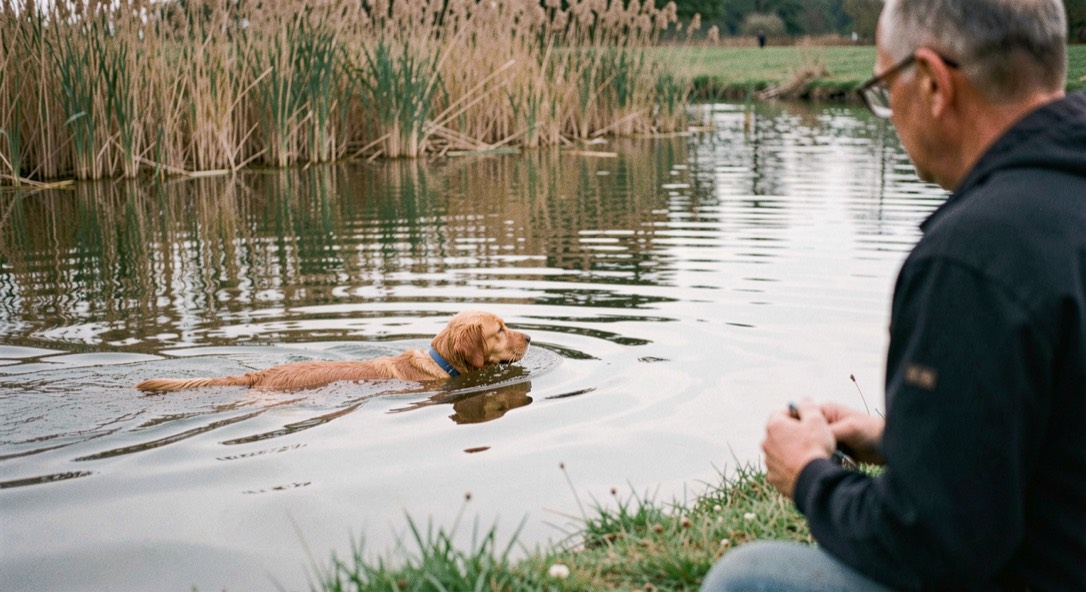
June sits in the quiet half of the gundog year. Most field trials run across the autumn and winter shooting season, so a June water test on a retriever card belongs to the working test summer of dummies and club grounds. It looks simple: a dog, a pond, one send. Behind the send sit a certificate, a season rule and a short list of ways to fail.
The shortest exercise on the card
The regulation defines the water test in one sentence: the dog must “enter water readily and swim to the satisfaction of the Judges”. The retriever judging guide makes the omission explicit, noting that there is no requirement to retrieve from or over water in such a test. Nor is a handler entitled to ask for a shot to be fired.
What is judged is the entry and the swim, and hesitation is not refusal: a dog may need more than one command to enter, the guide says, but should not be eliminated unless it will not go, and the difference is not hard to judge.
Why does a certificate hang on one swim?
Because for a retriever the title of Field Trial Champion is not complete without a water certificate and a drive certificate. The water certificate must be taken before two panel judges, one of whom must be on the A-panel, at the retriever championship, at a field trial open stake, or at a subsequent special test. The drive certificate also needs two panel judges with an A-panel judge among them, but only at the championship or an open stake, since no later special test exists for it. That asymmetry is the practical reason standalone water tests appear on club programmes and standalone drive tests do not.
The season line that gives June water its character
A special water test held for part qualification towards the title must be held between 1 September and 1 April inclusive, a window across the shooting season that leaves the summer out. A June water test is therefore a club working test exercise, not a step towards a title, a difference worth settling before you travel. Which of the two events you are watching is the first question at any rope, and the 2024 record answers it.
Spaniels and the hunt, point and retrieve breeds also need a water certificate for their titles, taken before two panel judges including an A-panel judge, at their championship, at a field trial stake or at a subsequent special test. Pointers and setters need neither, and no working test is held for them. The June pond belongs to the three sub-groups that swim for something.
What happens to a dog that will not go in?
The rulebook agrees across the sub-groups it covers. Failing to enter water is an eliminating fault at a field trial for retrievers and spaniels, and for the hunt, point and retrieve breeds it appears as refusal to retrieve or swim. In a working test it is a serious fault for all three. There is no version of gundog competition in which a dog that will not swim can be placed.
At a trial the condition attaches to the awards. If a separate water test forms part of a stake, every dog in the awards, and every dog given a Diploma of Merit or a Certificate of Merit, must have passed it. The guide adds a caution: this does not mean every dog must be tested in water whenever natural water retrieves happen to occur during a trial. The placings fill a card of their own; how that card is read has its own entry.
Can a dog fail water and try again?
Yes, and water is one of the few places in this sport where a bad day is not final. The certificate may be withheld where a dog has committed an eliminating fault during the test, and it must be signed by two field trial judges, one of them on the A-panel, but another attempt may be made on another occasion. The eliminating faults that end a retriever’s day include hard mouth, whining or barking, running in, being out of control, refusal to retrieve, changing game and chasing. The entry, not the retrieve, is the thing to build.
Warm water, and what the rulebook leaves to you
June water is warm, which makes the swim easier for the dog and changes the problems rather than removing them. The judges’ safety article applies whatever the season: judges should not require dogs to negotiate hazards, and the handler must be satisfied that the dog is suitably trained, physically fit and prepared for the work before sending it. Standing water in summer carries risks the regulation does not name, and a working test entry is not the place to discover that a dog cannot swim a distance. If the dog at your feet has never swum far, the honest send is no send.
Where water sits on the day’s card
In the working test classes a water test falls under unclassified, the class that also covers team tests and may bring together dogs from different sub-groups. Since February 2026 the retriever working test text says that whenever possible all dogs should be tested in water, and that except in puppy and novice dog or novice handler tests, dogs should be tested at a simulated drive or a walk up or both.
Even so, water arrives late in a dog’s education. The club’s introduction to the sport lists swimming and water work among the advanced exercises, after steadiness to flushed game, gunfire, direction handling and jumping, and it notes that most gundogs are not ready for competition for at least two years, a working test for members of the organising club the probable first outing. The full route in is set out on the club’s introduction to field trials.
A water test asks a dog to enter readily and swim, and the same unhurried progression serves a child at the poolside. Nothing is forced: short sessions, warm water, and stopping while it is still going well. Front crawl is the faster stroke, breaststroke the steadier one, and a Scottish club in Fife teaches both to children and adults in the same order, water first. The desk has set down how a young dog meets water beside the child’s first length, and the entry follows this page.
Where this comes from
The water test definition, the award condition, the shot rule, the season for special tests, the certificate requirements for retrievers, spaniels and the hunt, point and retrieve breeds, the eliminating faults and the judges’ safety article are in the Royal Kennel Club Field Trial Regulations 2026, read on 5 September 2026. The clarification that no retrieve is required, the caution on natural water retrieves and the rules on signature and re-attempts are in the retriever judging guide FT26, read the same day. Neither text fixes the June exercise itself: the distance swum, the far bank and the number of sends are set nowhere the desk has read, and where they are decided could not be established.