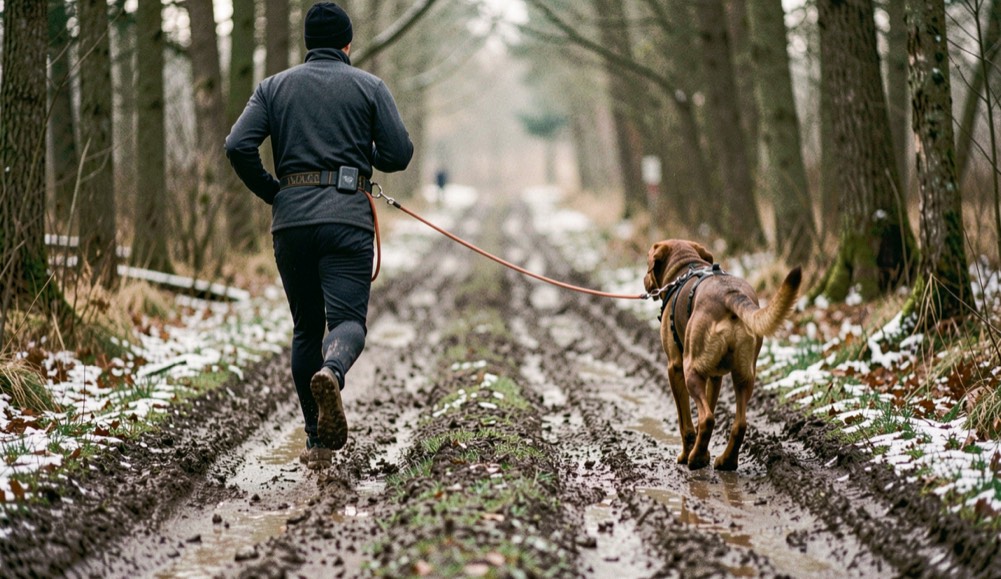
A first canicross season is short on mystery and long on logistics. The running is the easy part to understand. What newcomers actually ask about is when the season is, why the start is not a mass start, how far the classes are, and what happens if the day turns warm.
Why the season is winter
Dryland dog sport in Britain runs from roughly autumn to early spring, and it does so for one reason: a dog working in harness generates a great deal of heat and sheds it inefficiently. That is why organisers publish temperature policies and why races are shortened, moved to first light or cancelled outright when a day is unexpectedly mild. The exact threshold is set by the organiser rather than nationally, so it is a number to look up on the race’s own rules page rather than to assume, and it is the single most important line in any set of race rules you will read.
The shape of a race day
Most events are held on forest tracks, often on land managed by the national forestry bodies, because the surface is kind to feet and paws and the routes are wide enough to pass on. You arrive, you park, you find the registration tent, and you are given a number. There is usually a briefing that covers the course, the marshals and the passing rules. Then you wait, because you are unlikely to start when everybody else does.
Interval starts, and what they change
Dryland races commonly send competitors off at intervals rather than as a mass start, with each runner timed individually from their own start. The reason is dogs: a crowd of harnessed dogs held on a line together is a poor idea, and a strung-out field makes overtaking manageable. It changes the psychology of the race completely. You are not chasing the person in front, because they may have started ninety seconds before you. You run your own race against a clock and find out where you came afterwards.
Passing has its own etiquette and its own rule, and this is worth learning before you need it rather than during. The overtaking runner calls to warn the runner ahead, and the runner ahead is expected to give way, usually by moving to one side and shortening the dog. Getting two lines crossed at speed is the most common way for a race to go wrong.
Classes and distances
Classes are usually divided by sex and by age band, with junior and veteran categories, and by the number of dogs being run. Distances at British events are typically in the region of a few kilometres rather than half marathons, because the dogs are working hard, but the exact distance is set by the organiser and by the course available. Bikejor and scooter classes normally run on the same site on the same day over a longer loop.
What a first season is really about
- Fitness in both of you. The dog is the one who cannot volunteer that it has had enough, so the build-up is the handler’s responsibility.
- Kit that fits. Three pieces do all the work, and a harness that rubs will end a season faster than a lack of training.
- Reading the rules of each race. Minimum age, temperature policy and mandatory equipment are set race by race in this sport, and two organisers a hundred miles apart may genuinely differ.
- Learning the tracks. A forest course in February is a different surface from the same course in October, and pace expectations should move with it.
The minimum age is not one number
This is the question newcomers most often get a wrong answer to, because the answer depends entirely on who is running the race. Four published British and international rule sets, read on 5 September 2026, say four different things.
| Rule set | Canicross | On wheels |
|---|---|---|
| IFSS race rules 2024 to 2026 | 18 months | 18 months |
| British Sleddog Sports Federation | 18 months, or 12 in the recreational class | 18 months, or 12 in the recreational class |
| CaniX | 12 months | no wheeled class published |
| Canicross Midlands | 12 months | 18 months |
Only one of the four rule sets separates foot from wheel: Canicross Midlands opens canicross at twelve months and holds bikejor and scooter to eighteen. The federation exception is written once and applies to its recreational class whatever the discipline. Read the rules of the race you have entered rather than the rules of the race you read about last time.
Heat, and the only number that really matters
The international rules used at federation level set out a graded scale, and the heading on it matters: the annex is titled guidelines, and the federation defines a guideline as a rule that is not mandatory but highly recommended. The decision belongs to the race jury together with the organising club, and the scale is what they decide from. Below 18 degrees for canicross and 16 for every other class, with humidity under 85 per cent, competition is normal. Above 16 and below 18 the distances drop to the published minimums, with that ceiling set at 25 degrees for canicross classes rather than 18. Between 18 and 22 degrees the distance drops to a kilometre and a half for demonstration only, canicross excepted. Above 22 degrees no team is harnessed at all, canicross excepted again. If the temperature reaches 18 degrees the race marshal calls a meeting with the race vet, and the vet’s opinion is to be the deciding one. Watering points are required at least every three kilometres.
One British organiser goes further and publishes a wet bulb globe temperature policy instead, measured half an hour before the start with a continuous monitor, because that figure takes humidity, wind and sun into account rather than shade temperature alone: above 14 degrees WBGT the long and short courses are shortened, and above 20 no dog goes on the course except the under sevens, who run a very short distance. That is the most useful thing a newcomer can read, because it explains why a race can be cut short on a day that does not feel hot.
A first canicross season asks a great deal of a dog’s body, and the cold months leave their marks. Between race days, the question of who treats the working dog besides the veterinary surgeon is worth setting down. In Germany, a formal training path for animal health practitioners can be begun without the Abitur, and the coursework covers anatomy, physiology and the methods themselves. Whether distance study or attendance suits a handler is a separate matter. The desk has filed a note on care between sessions, and on where that work stops.
Where this comes from
The equipment, distances, start intervals, temperature scale and watering rule are in the IFSS race rules 2024 to 2026, hosted by the British Sleddog Sports Federation, whose own race rules carry the British amendments. The twelve month entry age, the class distances and the passing rule are published by CaniX. The wet bulb policy is published by Canicross Midlands. The September to May season is stated by the BSSF. All read on 5 September 2026.