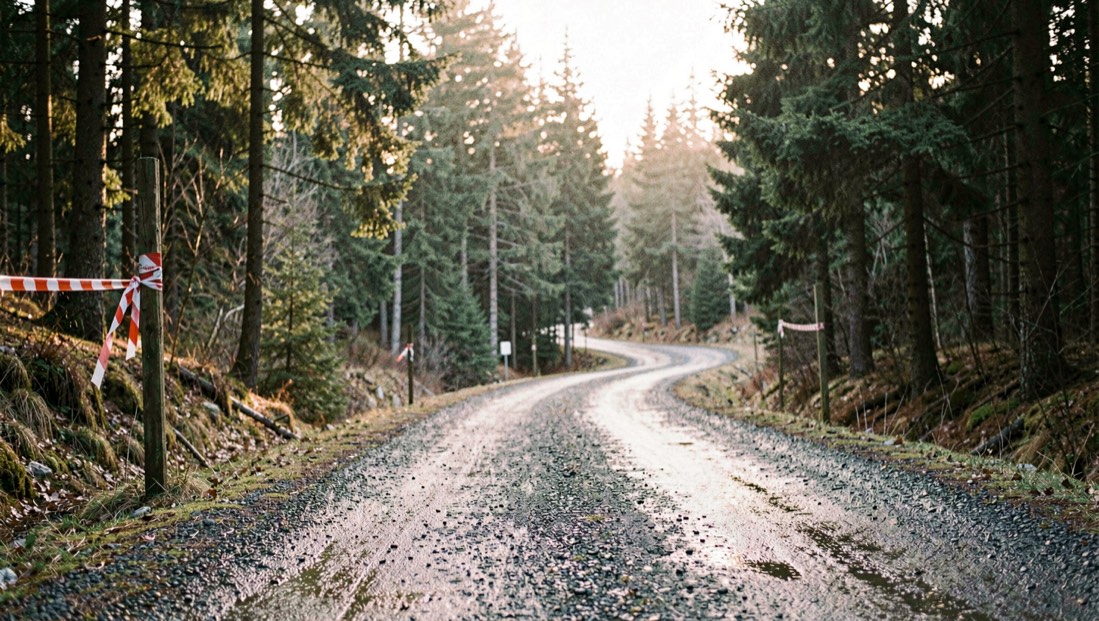
Watch a dryland race and the trail looks like a forest track with tape on it. Read the rules and it turns out to be a specification, most of which exists to keep two teams from meeting each other at the wrong moment.
The design rules
- Built for the biggest team. The trail must be safe for dogs and drivers, with special attention on turns and downhill stretches, and the whole thing is to be constructed with consideration for the fastest and biggest teams expected to take part. An eight dog rig, not a single canicross runner, sets the standard.
- No self-crossing. The trail must not cross itself. A second lap over the same ground is allowed, but not back through the start and finish area.
- Room to pass. Trails are to be broadly constructed, as far as possible, to make passing easy, with enough space between lanes that teams do not distract each other.
- Away from cars. The trail is kept away from parking areas, and a busy road may not be crossed at grade unless it is closed, in which case the crossing is at ninety degrees.
- A start and a finish with dimensions. The starting chute must be at least thirty metres. The finishing zone must be at least 800 metres long, or 150 metres for canicross, wide enough for passing and with no sharp turns.
- Surface. The international canicross rules add that the organiser must make sure the trail soil is not abrasive to the dogs’ paws, that asphalt is at most a tenth of the course and never at the start, and that the trail must be chosen so that its soil holds up in every weather, heavy rain included, without breaking down.
The one width the dryland trail rules fix in metres is the starting chute, a minimum of thirty metres long and four metres wide. Past the chute they ask for a trail broadly constructed to facilitate passing, which is a judgement rather than a measurement, and this entry does not invent one. Numbers do appear elsewhere in the rulebook, for snow trails and for the exchange and finish chutes; none of them governs the width of a dryland course.
Why there is no mass start on wheels
Mass starts are not allowed in bikejor, scooter and rig classes, because of the potential risks. Dryland races therefore run on intervals: thirty seconds or a minute in one dog classes, one or two minutes in two to eight dog classes, two or three minutes with ten dogs or more. Organisers may run a long interval in the first heat and a short one afterwards, and a final heat can be started as a pursuit, with the gaps from the standings used as the gaps on the start line.
Passing, and the word you shout
The command is trail. On that call the team being overtaken must give unimpeded way: in canicross, runner and dog hold the same side of the trail and slow down; in bikejor, the same, and the rider stops pedalling. The request is made when the lead dog comes within fifteen metres. Teams following each other keep at least one team length apart. In the finishing zone nobody has right of way any more and the passing rule stops applying, which is why that zone has to be long and straight.
What a wheel adds to the kit list
The line runs from the dog to the bicycle or to the rider, with a shock absorber, and it must be not less than two metres and not more than three when extended, measured from the rear of the dog to the front axle. There must be a working brake on each wheel. Every driver must wear a helmet approved by a national test registry, and a back protector is strongly advised for juniors. Propulsion comes only from the rider and the dogs: electric assistance is a disqualification.
The little rod with a ring on it that holds the line clear of the front wheel goes by several names in Britain, antenna, bike arm or bayonet. Under the international canicross federation rules it is explicitly recommended and not compulsory, and the line is fixed under the steering bar and above the fork.
Rigs, in numbers
The multi-dog classes have a vehicle specification. British federation rules require a minimum of three wheels for the four dog and six dog registered nordic breeds classes and four wheels for six dog open and eight dog classes, a minimum wheel diameter of thirty centimetres, a minimum wheelbase of 110 centimetres, a minimum track of seventy centimetres, a ten per cent tolerance on those figures, and working brakes on all wheels. Dog drop check points may be provided at least every three kilometres, and where they are, they carry a lead or another way of securing a dog, and water. A dog dropped at a check point does not start in a later heat; and where a race provides no way of dropping a dog at all, a driver whose dog becomes unfit or refuses to go on is not permitted to finish the heat.
A guardian dog lives with the flock and settles threats before they arrive, while a sheepdog must never take that role: it works the stock, and any grip on a ewe ends its day. A Swiss breed portal describes the Kuvasz as a livestock guardian, not a herding breed. On the ground the difference is plain: one stays out with the sheep, the other comes in on command. The two jobs sit close in size and opposite in purpose, and dogs bred for a different job sets out how each is asked to work.
Where this comes from
Trail design, start intervals, passing, the bikejor and rig equipment rules and the dog drop points are in the IFSS race rules 2024 to 2026, appendices C and D and rules 24, 80 and 82, together with the British amendments in the British Sleddog Sports Federation race rules. The surface requirement, the antenna and the helmet and gloves rule are in the International Canicross Federation rules 2025. All read on 5 September 2026.