The first field trial you try to enter will teach you more about the sport than the first one you watch. The process is entirely written down, it has a fixed order, and none of it is negotiable at the ground.
The schedule is the contract
A society running a trial must publish a schedule on the Royal Kennel Club pattern. It has to state the definition of each stake and the maximum number of runners, the date and place, the order in which the stakes will be run, the judges by name and identification number except in exceptional circumstances, the entry fees and prizes, the closing date for entries, and the date, place and time of the draw together with how the full result will be notified to entrants. Once published it cannot be changed without permission. If you read only one document before entering, read that one.
Closing dates and what an entry is
Entries or nominations must close at least fourteen days before the stake. The regulation distinguishes an entry, which is an application on the official form for a named dog, from a nomination, which is an application to be allowed to enter: where a ballot is held, those drawn out are then sent the entry form. Your dog has to be registered in the Royal Kennel Club Breed Register in the owner’s name, or hold an Authority to Compete number, at the time of entry.
The ballot, and why it is not random
When entries exceed the permitted number of runners, the right to compete is decided by ballot. In an open stake, though, the ballot is run in a prescribed order of preference, and this is the part that catches people out. The order is: first choice of members holding qualifying awards, then second choice of members holding them, then first choice of non-members holding them, then second choice of non-members, then dogs of members with other awards, then dogs of non-members with other awards, then everybody else. A newcomer with an unplaced dog sits in the last group by design.
The qualifying awards that buy a place in the earlier groups differ by sub-group. For retrievers it is a first, second, third or fourth in a twenty-four dog open, a first, second or third in a one-day open, or a first in an all-aged or novice stake. For spaniels it is a first, second or third in an open, or a first in a novice or all-aged. For pointers and setters it is a first, second or third in an open, or one first or two seconds in an all-age, novice or puppy stake. For the hunt, point and retrieve breeds it is a first, second or third in an open, or any two of a first in all-aged, a second in all-aged and a first in novice.
The society must publish the result of the ballot in full to every applicant, including the preference each dog was entered under. If entries were taken through an online system approved by the Royal Kennel Club, the ballot has to be run in that same system.
Your number comes from the draw
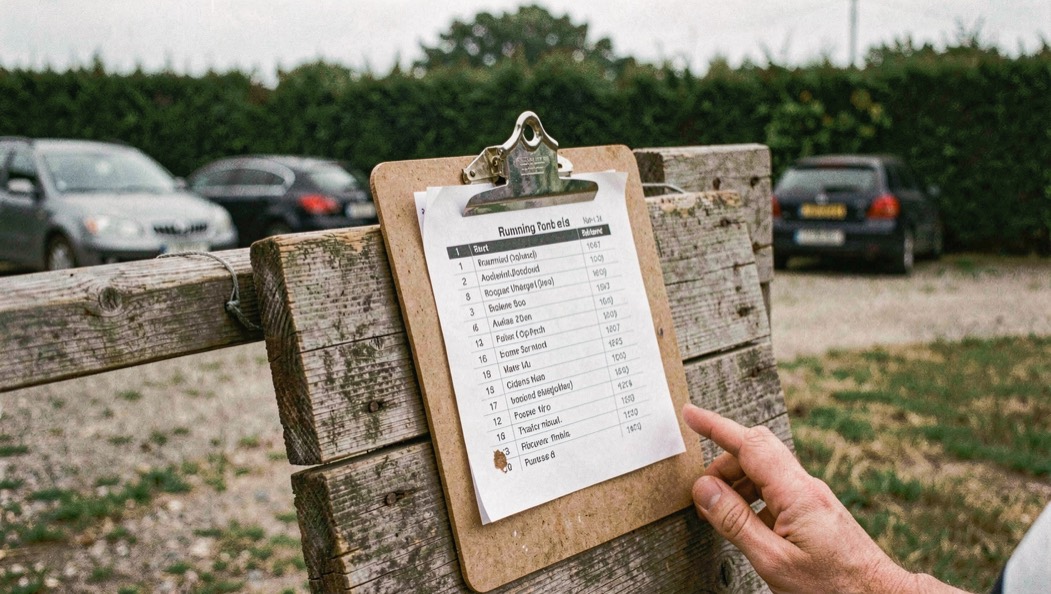
The draw for the initial order of running takes place as stated in the schedule, and each dog entered is given a number that accords with its place in that draw. At the ground you tell the field trial secretary you have arrived and are handed a numbered arm band, which you wear throughout. A handler must display only the number of the dog being handled at the time.
One point of vocabulary. In British shooting a peg is a gun’s stand at a driven day. It is not the dog’s number at a trial, and the field trial regulations never use the word in that sense. If you read that a trial dog draws a peg, the writer has borrowed the wrong word.
Reserves, fees and not turning up
If twenty places exist and you are number thirty-two, you do not run unless twelve people ahead of you withdraw. That is worth planning a day around before you set off. Having been drawn, or having accepted a place as a reserve, you can be liable for the whole entry fee if you do not take your run, with five exceptions written into the regulation: qualifying out of a novice stake, qualifying for a championship after the closing date, a veterinary certificate saying the dog is unfit, a medical certificate for the handler, and withdrawal more than seven days before the event.
Being present matters too. A competitor who is absent when the chief steward announces the start, and whose number has already been given to the next reserve, loses the run, unless the chief steward accepts that the circumstances were exceptional.
On the day
Spectators, dogs not competing and owners not running stay behind a red flag carried by a steward. The chief steward is present throughout and is responsible for seeing that the regulations are observed, while having no power at all over the judges’ decisions, which are final. At the end there are presentations, and competitors are expected to stay for them. If something has genuinely gone wrong, an objection goes to the Royal Kennel Club within seven days of the last day of the trial, with a fee of thirty-five pounds.
Where this comes from
The schedule contents, closing dates, ballot order, preference tables, draw and numbering, withdrawal liability, absence rule and objection procedure are in the Royal Kennel Club Field Trial Regulations 2026, read on 5 September 2026. The arm band, the red flag, the reserve arithmetic and the presentations are described on the Royal Kennel Club page Attending your first field trial, read the same day.