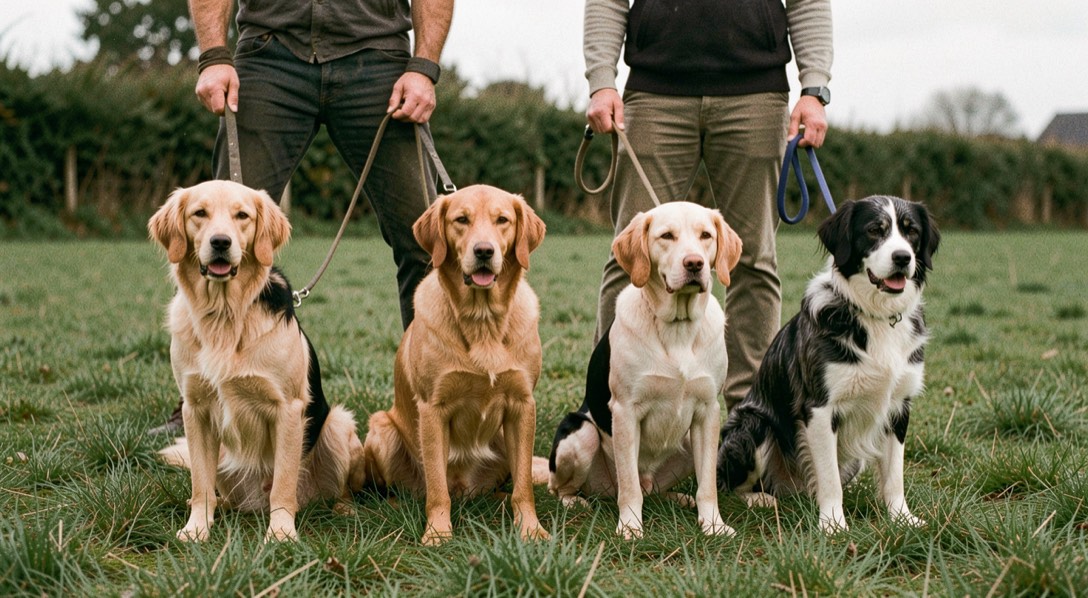
The name cocker spaniel covers two dogs that share a stud book entry and little else. In Britain the working cocker is bred, trained and judged on game found and retrieved in a spaniel stake, while the show cocker is judged on conformation to a breed standard. The split is not a matter of type preference; it is a split in what the dog is asked to do, and the two lines have been separated by function for roughly a century.
What does the word cocker actually mean here?
The word comes from woodcock, the bird the old cocker was expected to work. In Britain the cocker is a land spaniel: it hunts within gunshot, flushes game, and retrieves shot birds to hand. The Kennel Club recognises the breed as the Cocker Spaniel, and the working and show populations sit under that one breed name. The American cocker spaniel is a separate breed in the United States, recognised as such by the American Kennel Club, and it is smaller, heavier in coat and different in head and muzzle. A reader comparing the two will find the American breed described in detail in an American Cocker reference, which sets out the compact sporting build, the merry temperament and the colours the AKC recognises, and notes the differences from the English cocker. That is the reference point for anyone who has met the American dog and now meets the British one.
What is a working cocker asked to do in a spaniel stake?
A spaniel stake is a field trial or working test for spaniels, run under rules written by the Kennel Club and reviewed by its field trials committee. The dog works a beat, quartering the ground in front of the handler, within a defined distance, and must flush game rather than chase it. The handler keeps the dog in contact, turns it on whistle or hand signal, and the dog must sit to flush. Once a bird is shot, the dog is sent for the retrieve, which may be a marked retrieve it saw fall or a blind retrieve it did not.
Judging is by marks. A typical stake scores the dog out of twenty for each of several elements: quartering, steadiness, retrieving, and control. A dog that breaks at the flush, whines on the lead, or ranges beyond the beat loses marks, and repeated faults remove it from the stake. The distances are concrete: a spaniel is expected to hunt within roughly fifteen to twenty metres of the handler in thick cover, and to retrieve from further out over water or open ground. The work is close, fast and repetitive, and the dog is judged on how it does it, not on what it looks like.
Why did the two lines separate?
The separation is usually dated to the early twentieth century, when show breeding and field breeding began to select for different things. Field breeders wanted a dog that could work a full day, with a lighter build, less coat and a stronger hunting instinct. Show breeders wanted a dog that matched the standard, with heavier feathering, a longer coat and a more profuse ear. The two populations became distinct enough that a working cocker and a show cocker can look like different breeds to a newcomer.
The Kennel Club still registers both under the Cocker Spaniel, and a working cocker can be shown, and a show cocker can be worked, but in practice the lines are kept apart. Field trial entries are dominated by working lines, and show entries by show lines. The split is customary rather than regulatory: the rules do not forbid a show-bred cocker from running in a stake, but the dog must meet the same standard of work, and few do.
How does an American breed reference describe the same dog?
An American breed reference describes the American cocker spaniel, not the British working cocker. The American dog is smaller, with a domed skull, a shorter muzzle and a heavier coat, and it is shown in a different trim. The reference covers the standard, the colours recognised by the AKC, the care of the feathered coat, the first year of the puppy, health screening and training, and it is explicit about the limits of general information against veterinary advice. It also sets out how to read canine sources critically and how to assess a breeder, which is useful to anyone comparing the two dogs before a decision.
The practical point for a British reader is that the American cocker and the British working cocker are not the same animal, even though both are called cocker spaniels. The American reference is the place to check the American breed; the Kennel Club rules and the field trial schedule are the place to check what a British spaniel stake asks.
What is the same and what is different?
Both dogs are spaniels: they hunt, flush and retrieve, and both are expected to be steady to game. Both are merry, busy dogs that need work or a substitute for it. The differences are in build, coat and the balance of instinct. The working cocker is lighter, with less feathering, and is bred for the beat and the retrieve. The American cocker is heavier in coat, with a shorter back and a more profuse ear, and is bred for the show ring and the home.
A reader who has only met the American dog should not assume the British working dog will look or behave the same. A reader who has only met the working dog should not assume the American dog is a smaller version of it. The names overlap; the dogs do not.
What should a newcomer check before choosing?
First, decide what the dog is for. If the aim is a spaniel stake, the working lines are the practical choice, and the breeder should be able to show the parents’ trial records. If the aim is the show ring, the show lines are the practical choice, and the breeder should be able to show the parents’ show records. If the aim is a companion, either line can work, but the working dog will need more exercise and more training to stay settled.
Second, check the health screening of the parents. Both lines have breed-specific conditions, and the relevant schemes are published by the Kennel Club and the breed clubs. Third, read the rules of the body that runs the event you intend to enter. The Kennel Club publishes the field trial regulations and the spaniel stake schedule, and the schedule states the classes, the entry conditions and the awards. The regulations are the authority; the customs of a particular trial are not.
Finally, keep the three registers apart. What the regulation says is written down and dated. What is customary varies between trials and between handlers. What is unknown, such as how a particular puppy will turn out, cannot be settled by reading. A newcomer who keeps those three apart will not be misled by the overlap in the name.
The word cocker, read in a British context, names a type before it names a breed, and the work asked of a working cocker in a spaniel stake is hunting, flushing and retrieving to shot, judged on quartering, steadiness and delivery. The two lines separated because show and work were bred to different ends. A closing note on the classes themselves, novice, aged and open stakes, sets out what each is confined to and why a class seen advertised may not be a Kennel Club stake at all.
Where this comes from
The documents read for this entry, on 24 August 2026: thekennelclub.org.uk. Where a point rests on custom rather than a written rule, the entry says so.