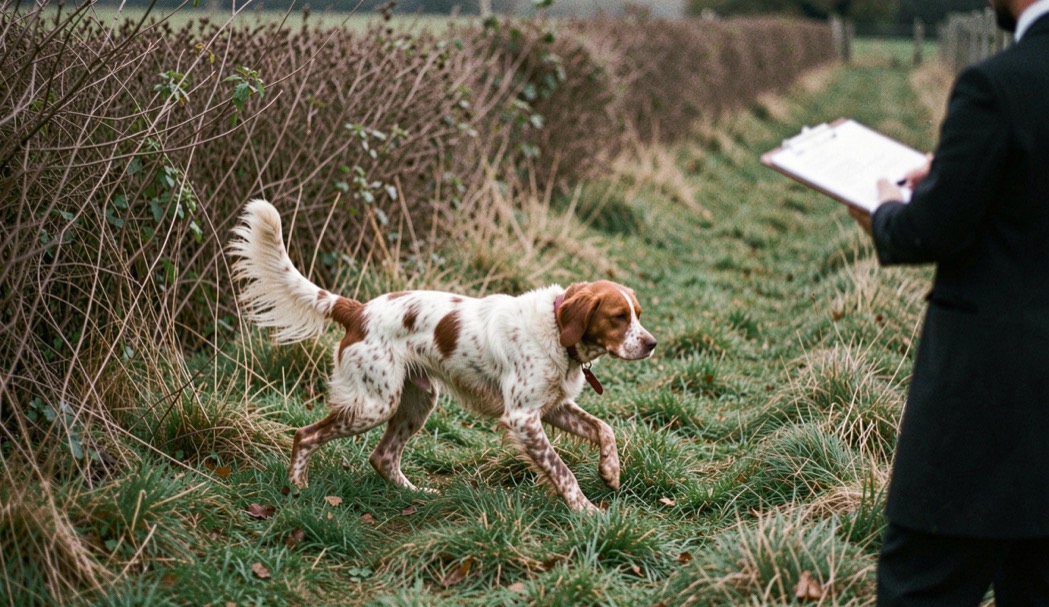
Stand at the rope in the middle of May and the calendar says nothing should be happening. The shooting season closed three months ago and the field trial year is in its quiet half, yet a spaniel is quartering cover in front of a numbered handler, a gun in the grass. The working test fills the empty months: for a spaniel it is the closest thing to the real job that can be built without game.
Retrievers were developed to gather game, cockers to flush and retrieve it, pointers and setters to range the fields after birds for the table, a division this record sets out breed by breed.
Where everyone stands on the beat
Spaniels run singly or in pairs, and where two run together the lower number takes the right-hand beat. The dog quarters systematically into the wind, as on a rough shooting day. When dummies are thrown with gunfire, the gun and the thrower walk at the edge of the beat being worked, in line with the handler, so the shot comes from where a gun would actually stand. The sequence is regulated: the shot must always precede the thrown dummy, the gun must be pointing where the dummy is going, and the gun must stand within shot range of the retrieve, wording tightened in February 2026 from a vaguer rule on distance. For unseen retrieves, gunfire is optional.
What is the dog actually asked to do?
The sub-group’s year-round requirement applies: quarter the ground hunting for game, be steady to flush, shot and fall, and retrieve tenderly to hand on command. Since February 2026 the text adds that the retrieve may be from land or water. The dummy is the only permitted retrieve object and the same type must serve throughout a given exercise. The regulation says nothing about cold game in a working test: the only dead game it allows anywhere in this family of events is at the conduct of a water test in a field trial. Exercises use seen and hidden dummies to probe retrieving and game finding, with directional control watched. Retrievers and the hunt, point and retrieve breeds share the format; pointers and setters have none.
How a mark goes to zero
The working test regulation carries its own fault list, shorter than the field trial’s but recognisably the same family: refusing to retrieve, whining or barking, running in or chasing, being out of control, failing to enter water, changing retrieve, and being without merit. Poor heel work is on the retriever list and not on the spaniel one, which is the sort of difference that only shows if the two are read side by side. Failure to complete an individual test scores zero, and a multiple retrieve counts as a single test, so dropping one leg zeroes the whole exercise.
The pigeon paragraph that was cut
The regulation used to allow live pigeons to be released to simulate a flush. It has been removed. If a flush happens while the dogs are hunting and it is not part of the test, they should not be asked to retrieve at that point, and the judge may ask the handler to redo the test. The pigeon has been retired from duty: a flush is now an accident to be managed rather than a set piece staged.
Who is marking, and against what?
Since February 2026 there must be a minimum of two judges, announced to the competitors. An open test needs at least one field trial panel judge from the relevant sub-group. The judges agree a common scoring system and state it before the first dog runs; individual tests are typically marked out of twenty, letter gradings appearing on days organised more like a trial. Tests must be achievable and relevant to the standard, and organisers may now check them in advance with non-competing dogs of that standard. The club’s spaniel guide adds that natural game finding counts above work that has to be handled, and noisy handling is a major fault.
The two years before the rope
The Royal Kennel Club’s introduction for newcomers sets out the ladder. Play training runs from eight weeks to six or eight months. Basic training starts there: walking on a lead, sitting and stopping on command and whistle, staying, the recall, retrieving, steadiness to a thrown dummy, sitting then moving, quartering, and heel work once hunting is established. The advanced list adds steadiness to flushed and moving game, gunfire, dropping to shot and marking, direction handling, jumping and water work.
The kit is short: slip lead, whistle on a lanyard, dummies. A legally docked spaniel may compete; a dog with no sight at all should not, on welfare grounds, partial vision excepted. Most gundogs are not ready before two years old, and the first competition is almost always a working test.
What a spring win actually buys
A novice win, or a place in the first three of an open test, moves a dog out of the novice class and buys preference when an open test is oversubscribed. No title attaches, nothing enters the Stud Book, and the day is open only to members of the club running it, which bites: over 700 field trials and many working tests run every year, and anyone set on a run is advised to join several clubs. How a ballot and a draw work is set out elsewhere in this record.
The Working Gundog Certificate suits handlers who want proof rather than placings: an assessment of control, obedience and temperament, open to crossbreeds and unregistered dogs once on the Activity Register, the tasks achieved listed on the certificate. Before any entry form, attend a day or two as a guest and read the standard from the rope.
The word cocker, in Britain, names a spaniel of a certain size and stamp, and it has long covered two dogs that are not the same dog. In a spaniel stake the working cocker is asked to hunt cover within gunshot, flush game to the shot and retrieve it, and to sit steady while another dog works. The show line was bred to a written standard, the working line to the ground it was shot over, and the two drifted apart. A new entry takes up the working Cocker in a test and how an American breed reference describes the same dog.
Where this comes from
The working test procedure, the gunfire sequence, the dummy rule, the fault list, the pigeon removal, the judging requirements and the scoring rule are in the Royal Kennel Club Field Trial Regulations including Gundog Working Tests 2026, section J(G), read on 5 September 2026; the amendments dated 2 February 2026 are listed there. The judging advice comes from FT27, the club’s guide to the J-Regulations for spaniels, and the training ladder, eligibility facts and certificate from the newcomer page linked above, all read the same day. What the documents do not fix is the ground: beat, cover and numbers are the organising club’s decisions, and no two spring tests ask the same questions.
royalkennelclub.com
The Royal Kennel Club licenses field trials and gundog working tests in Britain and writes the J-Regulations they run under. Its newcomer guide covers the four sub-groups, the training ladder, the kit and the route into clubs; the site publishes the Working Gundog Certificate rules, a club finder and the regulations as a pdf or printed booklet.